Is It Always This Hot In October?
I write this while breaking a sweat on the train from LA to SD and everyone seems to be frustrated with the most recent heat wave. Just last week, October 4th it was 104°F in downtown LA, where the average October temperature over the last 30 years is 69°F. First thing that comes to mind - this must be global warming. It seems each year is worst than the last, but how much of that is true?

This weeks high is definitely up there, and meets recent October highs for the past few years. In 2017, that was matched and recorded as the hottest day in 30 years (108°F in 1987). Now only 9 years later we hit that temperature twice - October 3rd and 5th - and had 4 days above 100°F, a new historical record. Definitely some eye-opening signs of warmer weather trends.
So, is the average temperature trending up?
Your damn right it has. Just not as much as I would have guessed, roughly 4°F if you look all the way back to the 1880s. Strangely enough, it was actually warmer in the 1990s (another thing for 90s kids to complain about). Looking at data from the Los Angeles Almanac, the trend is not a straight line. Additionally, if you were just focusing on the last 30 years you would probably think it’s cooling down.
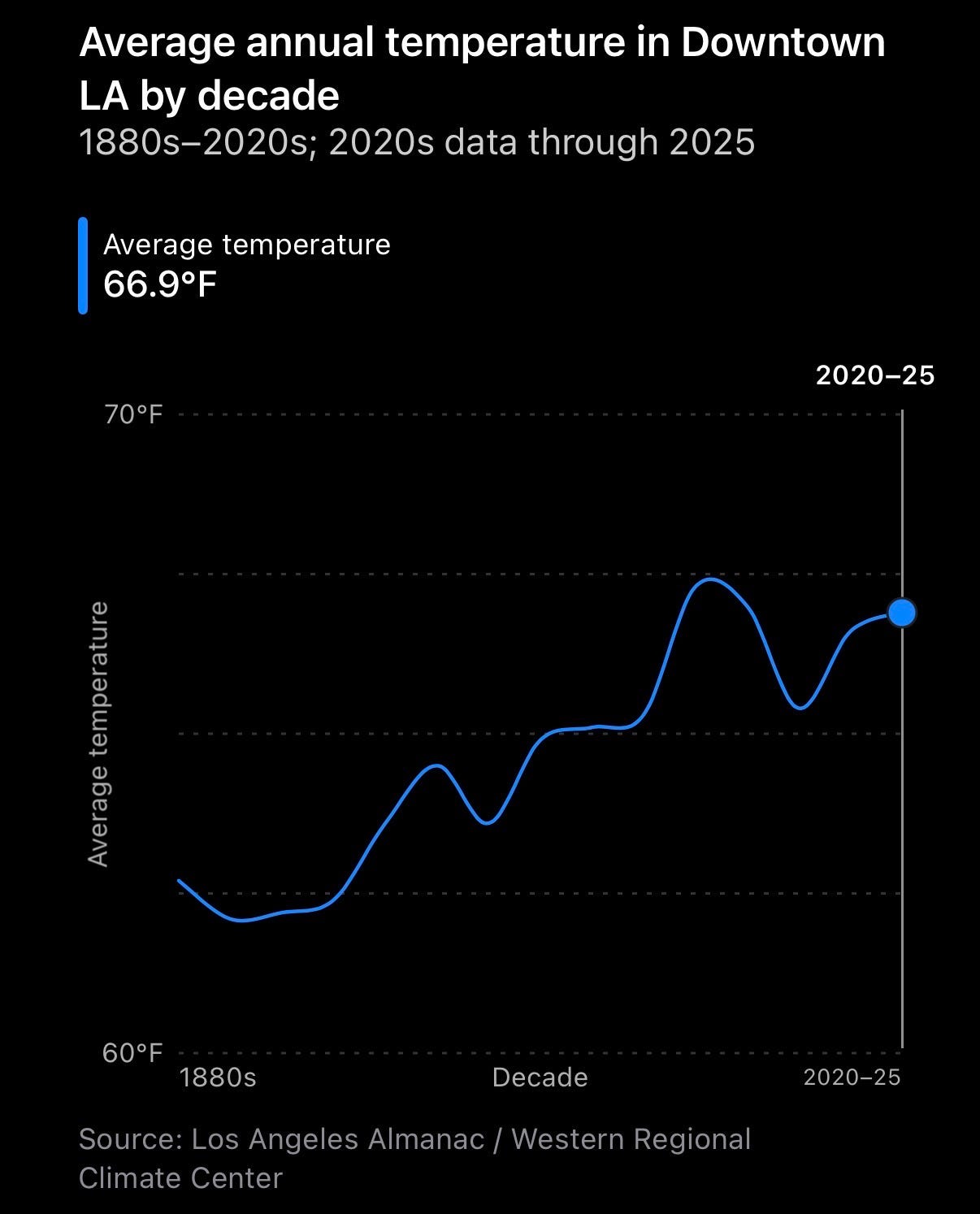
There are several peaks and valleys in this graph. Much like looking at the stock exchange, you can’t focus too much attention on short swings since that will not tell you much about its overall trajectory.
Is summer just longer now?
What’s crazy is scientists are beginning to come to an agreement that summer is expanding. A 2022 study looking at this considered a summer day to be any day with a temperature above the 75th percentile average for that timeframe. Looking throughout a 60 year period (1952-2011) they saw a 22% increase in summer days, or another 17 days! If only my university knew this when I was in school…
Not only is summer getting hotter and longer, winter is getting hotter and shorter. What makes matters worse is winter continues to warm up much faster than summer, about 3x the rate. For every 0.16°F summer trends upward, winter increases 0.47°F. If this trend continues, we could see winter slowly disappearing which will have massive impacts on agriculture, drought stress, increased fire season, and ecological shifts. Not only will it be more expensive to live in Southern California, but we are slowly losing our beautiful weather as well.
How much of this is global warming vs. natural swings in weather?
This is not a debate anymore. Temperatures are increasing due to human activity produced greenhouse gases. The Intergovernmental Panel on Climate Change (IPCC) mentions that since the late 1800s, human activity is responsible for 97% of global warming. I’m sure none of us reading this are surprised, as most people spending the time to learn about climate change see the overwhelming amount of data.
There are outlying factors that play into this year, like El Niño. A natural climate pattern that affects our pacific ocean, changing trade winds which inevitably increases ocean temperature. This feeds tropical storms and hurricanes which increases humidity on the coast and resist nightly cool-downs. Does this have an effect on the peak heat in LA? Probably not, but as an average temperature signal this will keep our nights warmer, inevitably having an impact on overall temperature. Though El Niño isn’t the major factor for this year’s heat, it plays an interesting role into other Southern California climate trends - more to this on another article.
Another focus, Santa Ana Winds. You have probably heard people mentioning this one before, but do you know what that actually means? Typically, Southern California deals with off-shore winds, coming from the ocean towards the coast. This has a cooling effect on the beach towns and that wind will continue to increase in temperature as it gets further from the cooling ocean. During the shift to winter months (October), deserts/mountains inland are cooling down much quicker which creates density in the air. That air naturally will work its way to less dense areas - like towards the coast - and by the time it makes it to us that wind has absorbed a lot of heat. This change of wind happens every year and is why we typically have a warm September into October. It does not answer why the average temperature has increased, though worth noting as a natural swing we see here in Southern California.
We’re Screwed…
Weather in Southern California can be affected by several factors, including storms, winds, fog, rain, and climate change, to name a few. Each can make a significant change per day, but it shouldn’t be a question that climate change has continued to become a real thing that we are facing. I don’t want 100°F days in October just as much as the next person, so what do we do?
As an environmentalist, I believe that we have to actively speak up and make daily choices to reduce our carbon footprint. Realistically, I fail this approach often. From my double cheeseburger at In-N-Out to forgetting reusable bags and even driving my personal vehicle, I have fully immersed myself in consumerism. I easily dismiss these choices by telling myself, “What difference is one person really going to make?”.
Luckily, there are people taking this seriously and making strides towards the right choices. Technology is developing in a way to reduce our carbon footprint, companies are taking pledges to become carbon neutral, policies are being enacted to promote green business, and food options are becoming more sustainable. Many people are concerned it’s not enough, which is totally fair, but I believe much like the temperature graph we can’t make assumptions of the future on recent peaks and valleys. Opportunity lies ahead.